FCS Students Earn Top Honors at Alameda County Science Fair
April 17, 2026
Fremont Christian School students continue to make their mark in the scientific community, earning top placements at this year’s Alameda County Science & Engineering Fair, which brings together top student researchers from schools throughout the county. Building on the strong tradition highlighted in previous science fair results, this year’s participants tackled complex, real-world problems across chemistry and molecular biology—demonstrating both technical skill and perseverance.
Advanced Research in Biology and Bioengineering
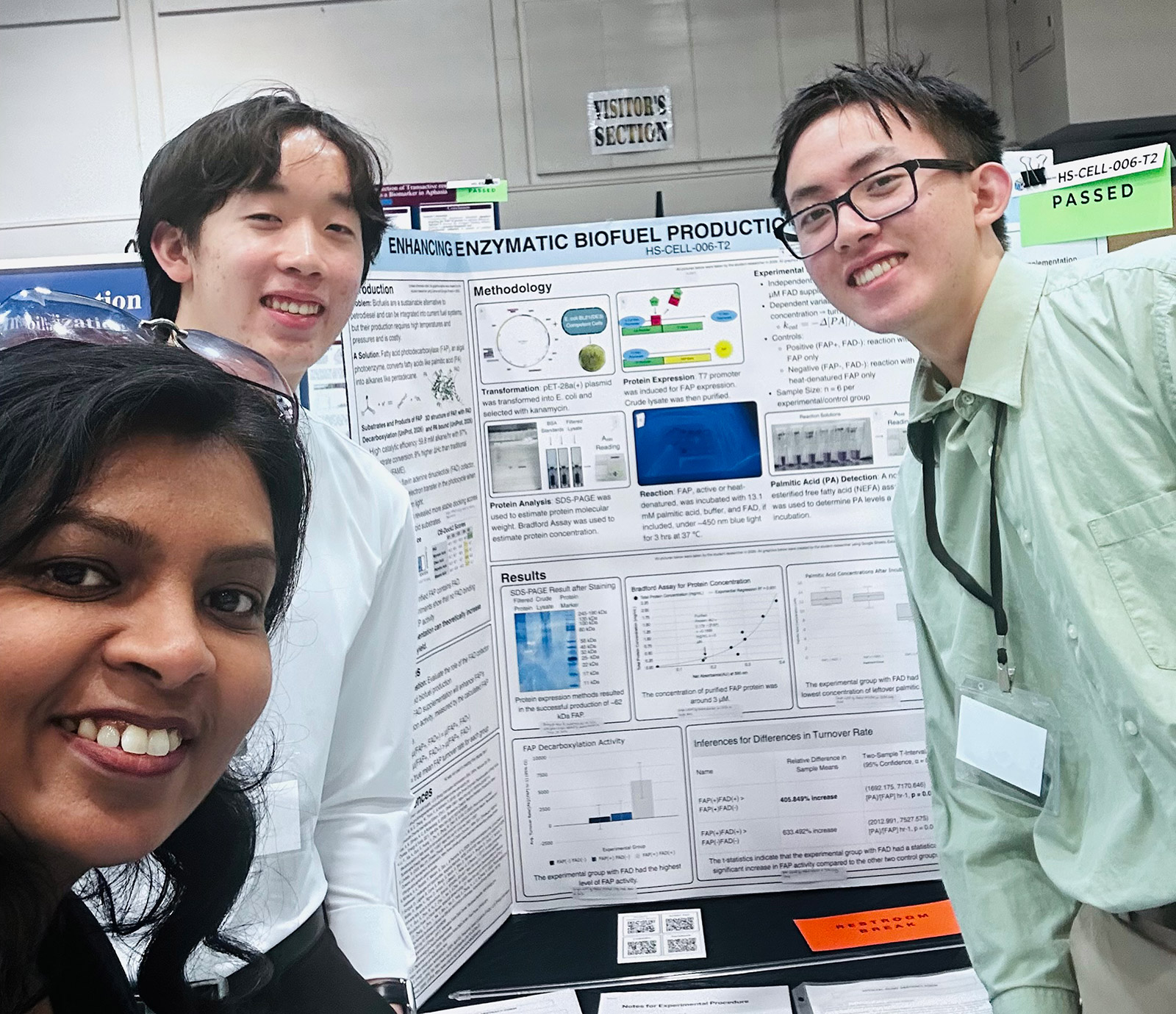
In the cell and molecular biology category, Matthew Du (12th grade) and Daniel Du (11th grade) earned second place for their collaborative project exploring enzymatic biofuel production. Their research focused on improving the efficiency of a specialized protein capable of converting fatty acids—such as those found in waste cooking oil—into hydrocarbons that could be used as fuel.
To scale their work, they engineered bacteria to produce the enzyme more efficiently, combining computational modeling with laboratory experimentation. The process required advanced techniques, including gene insertion, protein extraction, and activity measurement.
“Honestly, every single step was an obstacle,” Daniel says. “Only one step worked on the first try.” Failed trials and tight timelines forced the team to continually adapt—and each time, they prayed to overcome them. Despite these setbacks, they completed the project just weeks before the deadline.
For Matthew, the project marked a shift from theoretical work to hands-on experimentation. “This was my first time working in a wet lab,” he says. “It was the application of my previous work, which was more simulation-based.”
Applying Science to Real-World Problems
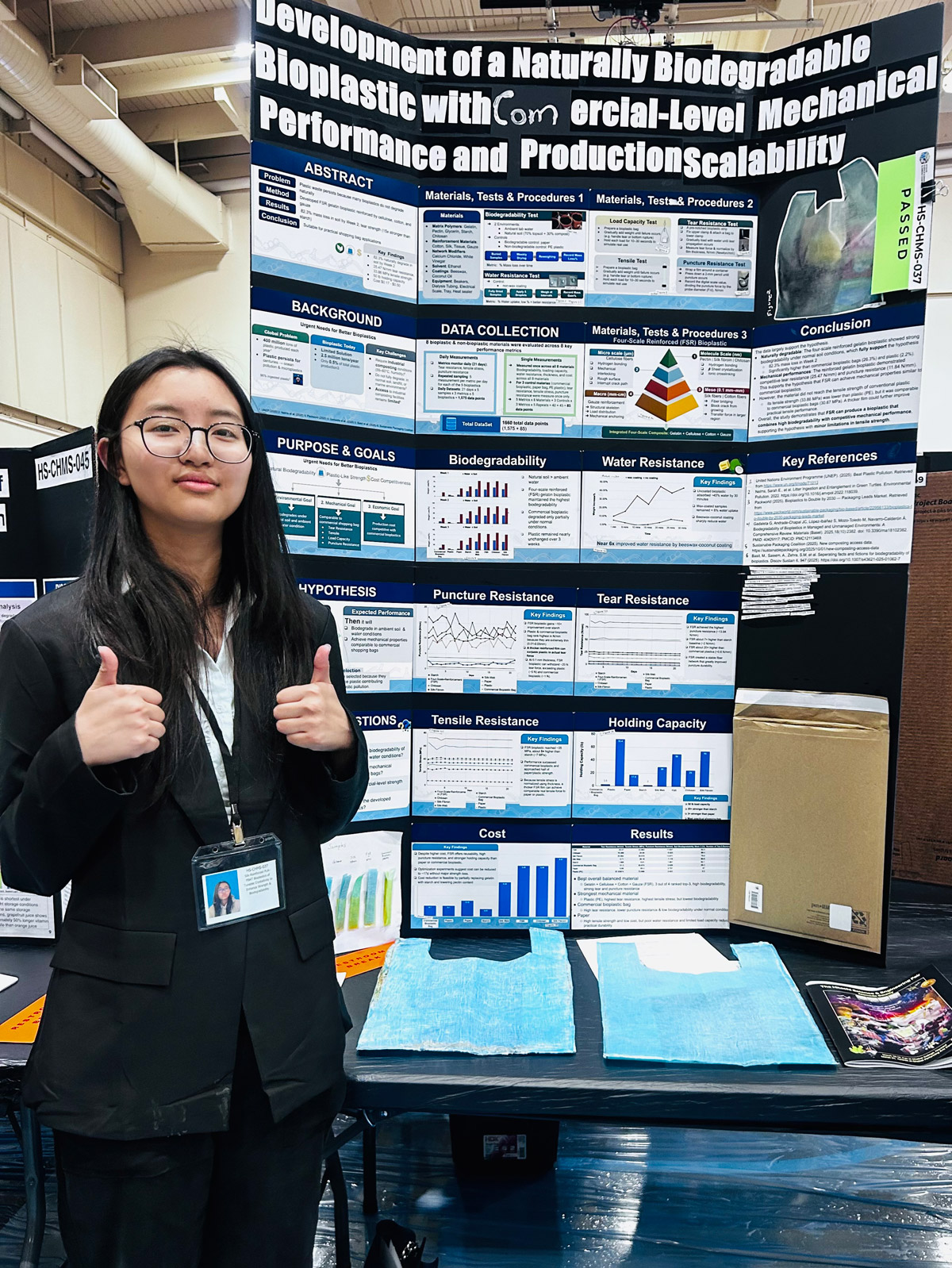
Junior Deija Lin earned third place in the chemistry category for her project focused on developing an environmentally friendly alternative to plastic. Drawing on extensive research, she experimented with multiple bioplastic formulations, combining different approaches to create a material strong enough for everyday use. Her final product—a fully biodegradable plastic bag—demonstrated both practicality and innovation.
“I combined different recipes to create a very strong bioplastic,” Deija says. “I turned that final result into a plastic bag so people are able to use it in everyday life.”
The process was not without challenges. “My goal was to make it function like a normal plastic bag,” she explains, “but also keep the cost down and make it comfortable to use.” Her reflections point to the kind of iterative problem-solving that defines real scientific work.
Investigating Everyday Science in the Classroom
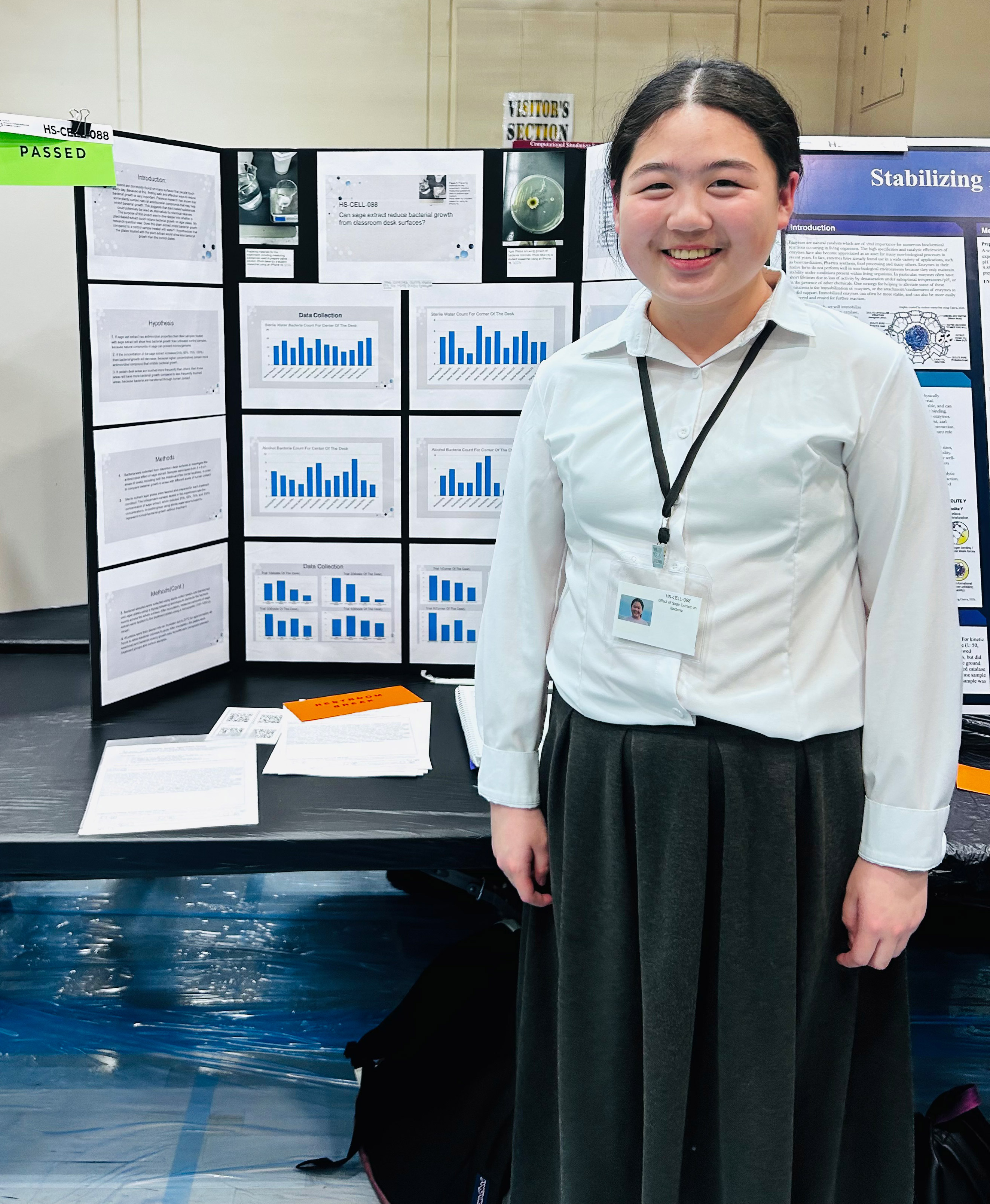
Sophomore Elaine Huang placed fourth in the cell and molecular biology category, with a project examining the antibacterial effects of sage extract on classroom surfaces. By testing different concentrations, she found that higher concentrations were effective in reducing bacterial growth, while lower concentrations showed little impact.
Her research required persistence. “In the beginning, the bacteria didn’t really grow,” she says. “I had to try different ways to make it grow.” Limited time and access to testing spaces added further challenges, but the experience ultimately reinforced the importance of patience and adaptability.
Learning Beyond the Results
Across all projects, students emphasized that the most valuable outcomes extended beyond awards. Deija described gaining a deeper understanding of research and the opportunity to learn from others at the fair. Daniel spoke about developing resilience under pressure, noting that the experience strengthened both his problem-solving skills and his faith. Elaine highlighted patience and persistence as key takeaways.
Their advisor, Mrs. Mohan, underscored the collaborative environment that made these achievements possible. She noted that even when students faced challenges, they continued to support one another, discuss solutions, and push forward rather than becoming discouraged.
She also emphasized the role of FCS’s lab environment in supporting student research. Equipped with advanced tools such as PCR (polymerase chain reaction) and gel electrophoresis systems, the lab allows students to engage in experimentation at a level typically seen in college settings.
Building a Culture of Research at FCS
Beyond their individual projects, Daniel and Matthew helped launch the FCS Research and Exploration Club, designed to mentor younger students and introduce them to scientific research. The club offers hands-on demonstrations and case studies to help students build foundational research skills, while also serving as a starting point for future science fair participants by offering guidance on project design, lab techniques, and competition expectations.
Students also shared practical advice for those considering participation next year. Time management was a recurring theme. “You should start as soon as possible,” Deija says. “Even if you think you have a lot of time, things might go wrong.” Elaine adds that patience is just as critical, emphasizing the importance of continuing to refine work even when early attempts do not succeed.
With strong mentorship, advanced resources, and a growing culture of collaboration, Fremont Christian School continues to prepare students not only to succeed in science fairs, but to think critically, persevere through challenges, and apply their learning to meaningful problems beyond the classroom.
Posted in
Academic Highlights