
Posts Tagged "science highlights"
Cultivating Growth: Exploring Our Bountiful Garden Science Program
July 31, 2023
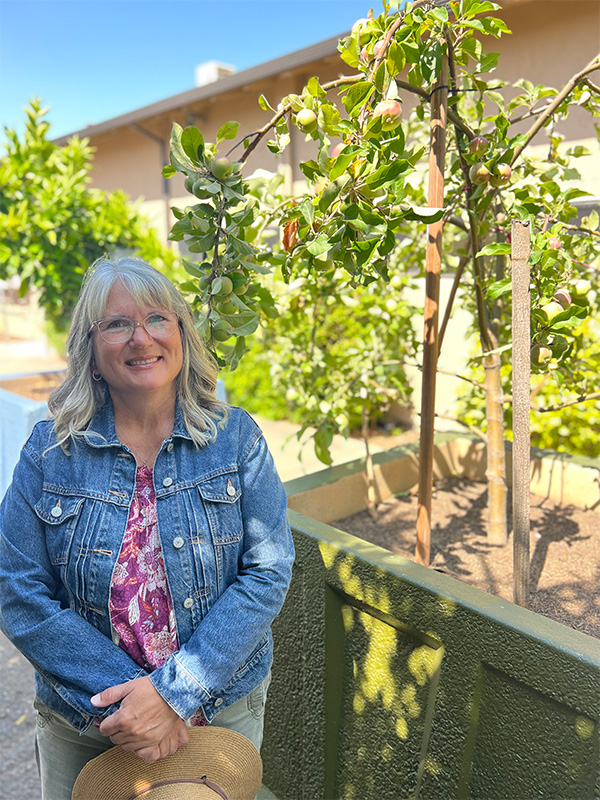
Among FCS’s many unique features, our thriving garden science program stands out as a testament to our commitment to nurturing young minds and connecting them with nature.
The purpose of the garden science program goes beyond mere horticulture. "We aim to develop certain values in the kids — curiosity, observation, engaging all the senses,” says Ms. Prewitt, our garden science teacher. “Our goal for the program is for students to learn stewardship, cooperation, and consistency, as well as how to find joy in tending to the plants.” The garden imparts valuable life skills, such as growing and preparing food, instilling a profound connection to the environment.
At FCS, garden science is a requirement in junior high and an elective in high school. “I give a questionnaire at the beginning of every trimester,” says Ms. Prewitt, “and some of the junior high kids just aren’t interested in the beginning. But it doesn't take long before they open up and become interested — almost fascinated. Most of them end up taking ownership of their garden responsibilities very seriously.”
Hands-On Learning and Collaborative Spirit
At the heart of our garden science class lies the spirit of hands-on learning. Students actively participate in planting, weeding, composting, and harvesting, witnessing the magic of growth firsthand. In the culinary portion of the garden science class, students learn valuable kitchen skills. “Some of them are amazed that we even let them hold a knife,” says Ms. Prewitt. “When they find they're given room to grow and realize how capable they are, they start to own it and really savor the experience. They want to experiment — to try this and try that. They have all kinds of ideas. It’s truly amazing to watch the transformation.”
Some of the favorite recipes from the last year include applesauce, bruschetta, pizza, homemade ranch dressing with veggie sticks, and hand-squeezed lemonade with lavender. This past year, the students grew and cooked artichokes, which was the first time many of them had tried the vegetable.
Even though Ms. Prewitt has detailed lesson plans, she gives her students a lot of leeway in decision-making, such as how many onions to plant or how much garlic to use in a recipe they’ve voted to make. “I think they stay engaged when they have more decision-making. They get a kick out of it.”
Our school garden yields a rich bounty throughout the year. Tomatoes, squash, peas, green beans, kale, onions, and lettuce thrive under the students' care. Edible flowers such as zinnias add both beauty and flavor to the garden and the culinary projects it inspires. “We just planted sunflowers with seeds harvested by another class,” Ms. Prewitt explains. “It's the whole process — the full circle, from seed to flower. The kids love that aspect of the class.”
The garden was founded by the former garden science teacher, Terry Gregory, who retired in June 2021. Both Mr. Gregory and Ms. Prewitt were trained by the Edible Schoolyard of Berkeley, a nonprofit founded by legendary chef Alice Waters, whose influence is still felt in the garden and the kitchen classroom.
Working in the garden also emphasizes environmental stewardship. “We've observed monarch caterpillars transform in the classroom,” Ms. Prewitt explains. “The students loved it, and some butterflies were attracted by the plants the classes planted to create a habitat for them.”
Overcoming Challenges and Family History Projects
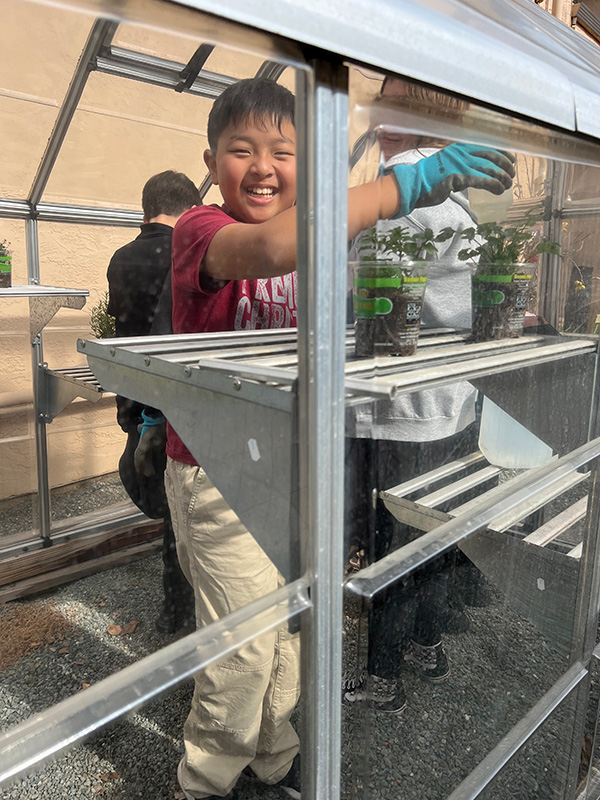
California's favorable climate means the garden can be run all year round. However, as with any garden, pest control can be an issue. Ms. Prewitt's solution involves organic methods, such as planting marigolds and using fabric screens to protect tender shoots.
Recently, the garden expanded, with four new beds and the butterfly garden, to make it a total of 21 beds and a greenhouse. But Ms. Prewitt is realistic about the rate of growth. “I think we've done some growing. Now we need to grow into the new space before expanding further.”
The garden science program also fosters meaningful connections between students and their family members. Ms. Prewitt describes one such project. “The students conducted interviews with their grandmas, grandpas, aunts, uncles, and other relatives about a food memory, many of which were memories from other countries. The stories were very touching. It was a really positive experience for the students — and probably for their relatives to be asked questions they'd never asked before or thought about before. I really enjoyed listening to the papers the students shared during those assignments.”
Posted in
Academic Highlights
FCS Students Honored at Alameda Science Fair
April 13, 2023
FCS is honored to announce the participation of four of our students in this year’s Alameda County Science and Engineering Fair on March 26. Three of our students even brought home awards, which is a remarkable achievement, especially considering there were nearly 400 projects presented from middle and high schools.
Ninth-grader Matthew Du, who was honored with third place in the category of High School Plant Sciences, Ecology, Agriculture, & Environmental Sciences, submitted his project on the effects of artificial or aquatic environments on crop yield, the results of which Matthew hopes will be scaled to benefit food production and reduce world hunger — an exemplary reflection of the community of compassion we strive to create at FCS. Matthew also took the time to present his project to his class after the fair.
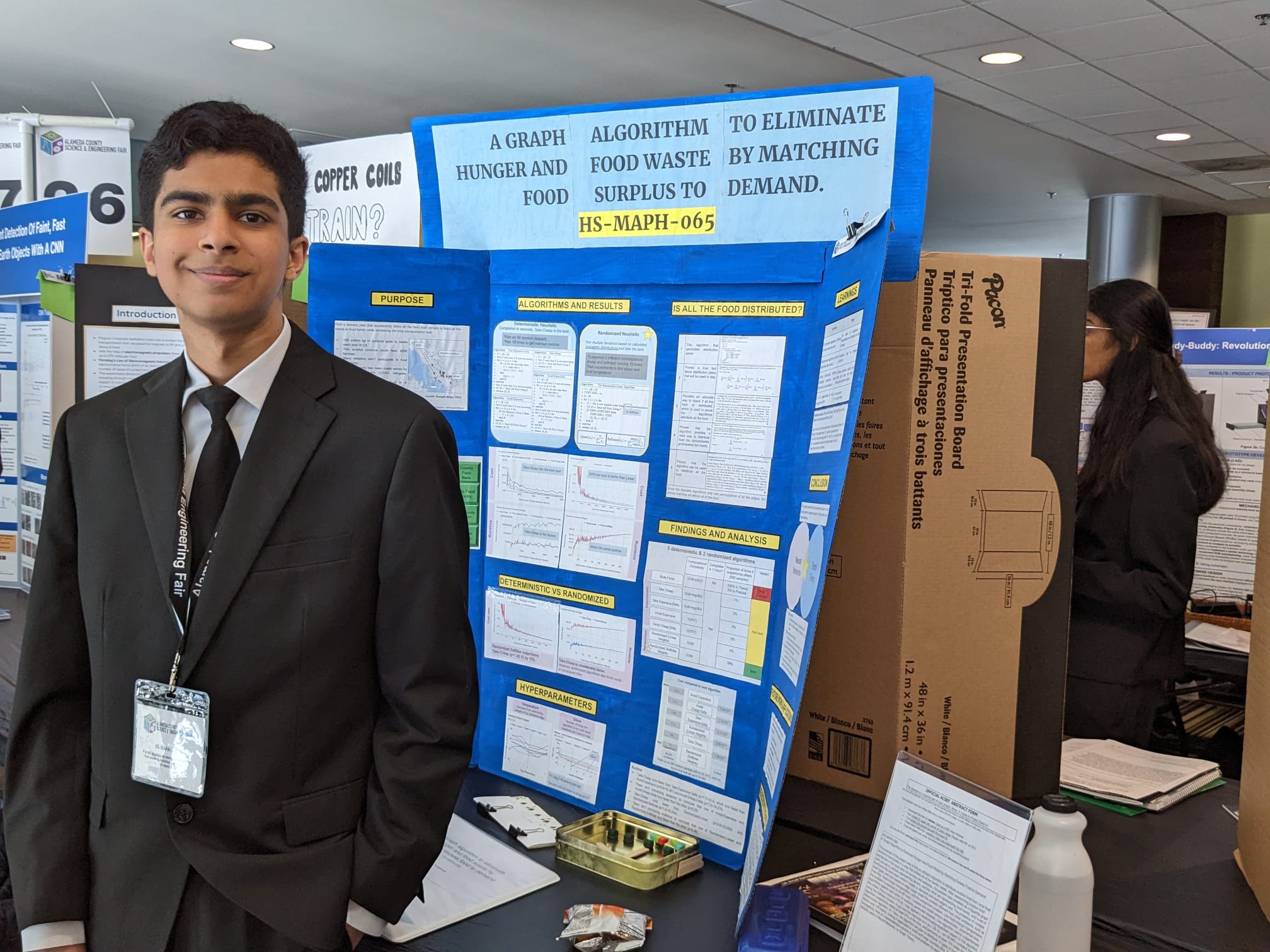
Another such project came from eleventh-grader Neil Makur, who aimed to create an efficient algorithm to cost-effectively distribute extra food from donors to fulfill the needs of food banks. “The best part about my experience was the journey,” says Neil. “I was able to combine skills from AP Computer Science A and AP Stats, as well as knowledge from my volunteer work at the food bank and other math courses, into a project that is applicable in the real world — and get great results. Mrs. Mathews was a great support.” Neil placed third in High School Math, Astronomy, Physics.
Neil’s classmate Sophia Li took home fourth place in the category of High School Biomedical Science for her project on preventing dance injuries in teenagers. “I enjoyed the journey of this research project,” Sophia says, “especially because I'm able to tie together my passion for dance and science and present my findings to experts in the field.”
“We're grateful for the space of independent growth that FCS provides for students, which has enabled our daughter to transform from quiet to confident during her high school years so far,” her parents said in a note to our head of school, Dr. Tricia Meyer. “Thank you again for the school's attention to students.”
.png) Tenth-grader Jared Jackson also participated in the fair, presenting his analysis of how potholes could be avoided — a noble cause indeed!
Tenth-grader Jared Jackson also participated in the fair, presenting his analysis of how potholes could be avoided — a noble cause indeed!
In addition to our future Nobel Prize winners, FCS also won the logo design competition. The winning trio of Daniel Du, Matthew Du, and Melody Zhang combined their creative talents to produce the image that appeared on much of this year’s fair marketing and merchandise.
FCS is very proud of all our science fair participants! Congratulations to you all!
If any student is interested in more information about participating in the ACS&E Fair or the logo competition, please see your science teacher.
Posted in
School & Community Events